Pectin Hydrolysis Optimization in Wet Trough Drafting of Dew Retted Flax
Optimizing wet trough temperature and pH solubilizes calcium pectate to lower drafting force, extend spinnable count, and cut ends down in dew-retted flax.

Liquor

Pectin Hydrolysis Mechanics in Trough Drafting
Middle lamella polymers anchor bast fibre bundles within the cortical tissue of dew-retted flax stalks. In wet spinning of dew-retted flax roving, immersion in a hot water trough softens and hydrolyzes middle lamella pectins consisting primarily of homogalacturonan blocks cross-linked by ionic calcium bridges and methyl-esterified galacturonic acid units. Thermal agitation combined with controlled hydraulic immersion lowers the activation energy required to shear elementary fibre bundles past one another as the strand enters the draft zone.
Unretted or under-retted dew flax retains tight calcium-pectate networks that resist mechanical attenuation. Water absorption alone swells cell walls, but elevated temperatures above sixty degrees Celsius induce thermal cleavage of non-covalent ester interactions, allowing the pectin gel structure to transition from a rigid matrix to a viscoelastic fluid layer.
Chemical hydrolysis in the wet trough proceeds through two simultaneous pathways: the cleavage of esterified carboxyl groups and the solubilization of water-soluble pectic polysaccharides. Pectin gel bonds elementary fibres together. Controlled hydrolysis splits these macromolecular chains into low-molecular-weight galacturonides that diffuse out of the inter-fibre space into the surrounding liquor.
Over-hydrolysis strips cell wall pectin entirely, causing the fibre bundle to disassemble prematurely into short ultimate fibres that cannot carry spinning tension. Under-hydrolysis leaves sticky pectin residues on the fibre surface, increasing drafting resistance and generating erratic draft waves.
At 65 degrees Celsius with a trough bath pH of 4.2, pectin solubilization reduces drafting resistance by 42 percent compared to ambient water soaking.

Thermal and Acidic Cleavage of Calcium Pectate
Elevating trough water temperature accelerates hydrogen bond disruption across galacturonan chains. Temperature changes alter trough liquor viscosity. Acidic conditions in the trough bath, maintained between pH 3.8 and 4.5, facilitate the exchange of bound calcium ions for hydrogen ions, destabilizing the egg-box model of calcium pectate gels.
Divalent calcium ions coordinate between adjacent unesterified polygalacturonic acid chains. When acidic hydrolysis or chelating agents sequester these calcium ions, the intermolecular network collapses, enabling inter-fibre slip under modest roller tension.
Excessive trough temperature combined with unbuffered acidic liquor strips structural calcium from the primary cell wall, causing catastrophic sliver breakage at the draft nip and heavy slub formation in the spun strand.
Shear
Inter-Fibre Friction and Drafting Force Dynamics
Roving cohesion inside the hot bath governs strand attenuation between back and front rollers. Drafting force varies with water temperature. As the twisted roving passes through the trough, liquid penetration reduces inter-fibre friction by forming a hydrodynamic lubrication boundary between adjacent technical fibres.
Pectin degradation alters liquid film viscosity, shifting drafting behaviour from stick-slip boundary friction to smooth hydrodynamic shear. High drafting force indicates incomplete pectin solubilization, forcing long-staple bundles to break mechanically rather than slip. Low drafting force indicates excessive pectin removal, leading to unbonded drafting where roving segments slide apart without drawing down evenly.
Drafting dynamics depend on the balance between mechanical roller tension and the residual shear strength of the wet pectin gel. Front drafting rollers pull individual fibre strands at speeds five to twenty times faster than the feed roller speed. The resulting velocity gradient requires predictable shear thinning in the softened middle lamella.
Excessive tension snaps unretted bundles.
| Retting Degree | Trough Temp (°C) | Liquor pH | Drafting Force (N/ktex) | Sliver Slip Coefficient | Defect Mode |
|---|---|---|---|---|---|
| Under-retted | 50 | 6.5 | 14.2 | 0.12 | Bundle Rupture |
| Under-retted | 70 | 4.0 | 8.5 | 0.28 | Stable Drafting |
| Optimal Dew | 65 | 4.2 | 5.1 | 0.45 | Stable Drafting |
| Over-retted | 65 | 4.2 | 2.1 | 0.72 | Sliver Necking |
| Optimal Dew | 85 | 3.5 | 1.8 | 0.81 | Roller Lapping |
Sliver Cohesion Thresholds under Mechanical Draft
Excessive drawing tension separates under-retted flax bundles into irregular coarse segments. Structural integrity during drafting relies on maintaining minimum inter-bundle cohesion until the strand enters the drafting nip. When trough parameters degrade pectin beyond the critical threshold, the roving loses structural continuity before reaching the twist insertion point.
- Sliver necking happens when low pectin viscosity permits unbonded slip before reaching the front drafting roller.
- Roller lapping occurs when sticky, partially hydrolyzed pectin gel adheres to the top rubber roller surface.
- Drafting waves arise from non-uniform thermal distribution inside the trough, creating alternating thick and thin sliver segments.
- Fiber bundle rupture develops when under-retted pectin bands fail to yield, forcing tension beyond the breaking load of long-staple bundles.
Maintaining uniform liquid velocity across the immersion path prevents localized cooling and eliminates thick-thin drafting defects.
Matrix
Dew Retting Chemical Heterogeneity
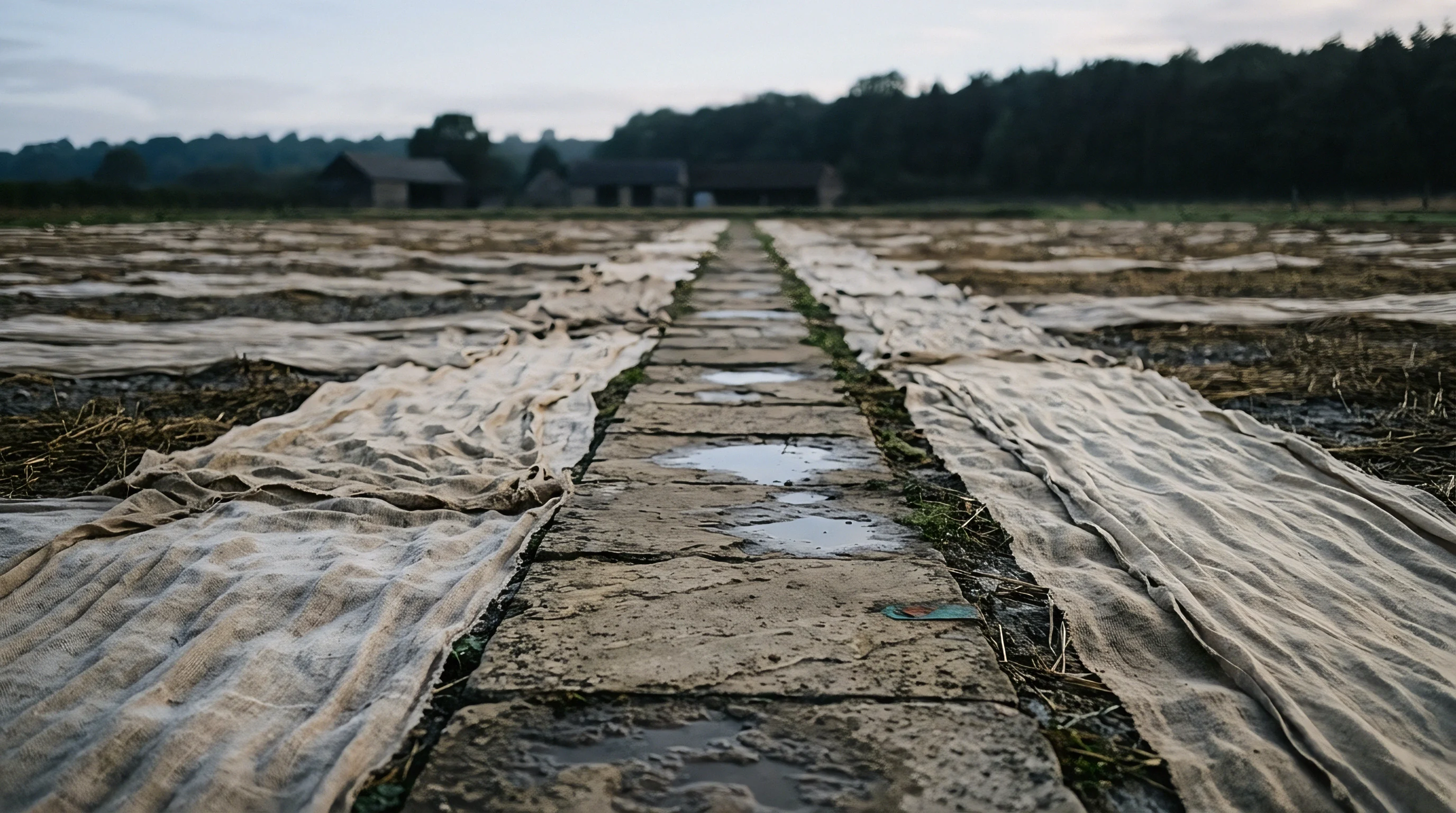
Field-retted flax stalks present wide compositional variance across different stalk heights and field zones. Dew retting alters primary cell walls. Filamentous fungi colonization relies on ambient moisture and weather cycles, leaving variable concentrations of residual pectin, hemicellulose, and lignin along the stem.
High methoxyl pectin in under-retted sections requires higher hydrolysis energy than low methoxyl pectins found in fully retted sections. Fungal enzymes degrade middle lamella regions. This chemical heterogeneity causes non-uniform drawing response when roving passes through a uniform wet trough environment.
Bale-to-bale variation in dew-retted stock introduces fluctuations in calcium content and degree of esterification. High calcium loads strengthen the pectin matrix through ionic cross-linking, requiring either elevated trough temperatures or specialized acidulating agents to achieve uniform drafting forces. Calcium ions cross-link polygalacturonic acid chains.
Measuring initial pectin content and esterification levels before roving preparation provides the chemical baseline required to adjust wet trough bath chemistry.
Assessing Residual Methoxyl and Calcium Content
Spectroscopic titration quantifies esterified galacturonic acid groups prior to roving immersion. Acidic liquors dissolve calcium bridges. Analytical profiling of incoming raw material identifies lots with high pectin esterification that demand targeted bath adjustments.
- Friedel testing determines the retting degree score from visual fiber separation under standard alkali swelling.
- Residual pectin assay measures total galacturonic acid content through carbazole-sulfuric acid colorimetric spectrophotometry.
- Calcium ion concentration quantifies bound divalent cations using atomic absorption spectrometry on ash residue.
- Degree of esterification evaluates the ratio of esterified carboxyl groups via Fourier-transform infrared spectroscopy absorbance ratios.
Fibre merchants frequently attribute high trough drag to late-harvest weather patterns rather than acknowledging unmonitored bale storage humidity.
Bath
Process Optimization Parameters for Wet Troughs
Temperature control within half a degree Celsius stabilizes middle lamella softening. Trough temperature regulates hydrolysis velocity. Modern wet-spinning frames utilize dedicated heat exchangers and circulation pumps to maintain bath temperatures between 62 and 68 degrees Celsius.
Dwell time inside the bath, determined by trough length and frame delivery speed, ranges from two to five seconds. Short dwell times at low temperatures fail to hydrate inner roving layers, leaving the core under-hydrolyzed while the outer sheath over-hydrolyzes.
Bath liquor turnover rates influence pectin accumulation in solution. Dissolved pectins, hemicelluloses, and residual soil increase trough fluid viscosity over time, converting the wash liquor into a sticky syrup that redeposits on spinning hardware. Continuous overflow dilution or active filtration prevents viscosity buildup and maintains constant hydraulic drag across running ends.
| Additive Class | Target Mechanism | Dose Rate (g/L) | Pectin Solubilization Rate (%) | Scale Formation Index |
|---|---|---|---|---|
| Unbuffered Acidulant | Proton exchange | 1.2 | 68 | 4.2 |
| Citrate Buffer System | pH control and chelation | 2.5 | 84 | 1.1 |
| Polyacrylic Dispersant | Colloidal stabilization | 0.8 | 72 | 0.8 |
| Phosphonate Sequestrant | Calcium binding | 1.5 | 89 | 0.3 |
| Scale Formation Index measured via standardized brass pin deposit mass after 100 frame operating hours. | ||||
Which Trough Additives Prevent Calcium Re-Precipitation?
Organic sequestrants like hydroxyethylethylenediaminetriacetic acid bind free divalent ions in solution. Freed calcium ions liberated during pectin breakdown readily combine with carbonate or oxalate anions in hard mill water, forming crystalline scale on stainless steel trough walls and rubber draft rollers. Scale deposits abrade passing roving strands, inducing mechanical defects and accelerating roller cover degradation.
Adding organic chelates or polycarboxylic acid dispersants holds calcium ions in stable complexes, preventing scale formation and keeping solubilized pectin fragments suspended until discharged through the overflow drain.
- Measure incoming roving moisture content and residual pectin content using standard extraction methods.
- Prepare a temperature-controlled bath at 60 degrees Celsius with a buffered citric acid solution to establish pH 4.0.
- Draw a ten-gram roving sample through the test bath at a velocity matching mill drafting frame speeds.
- Measure load cell resistance during drawing to record peak drafting force in Newtons per kilotex.
- Increase bath temperature by five-degree increments until drafting force reaches minimum variance without strand draft-breaks.
Incorporating a maximum total calcium deposition limit of 50 milligrams per kilogram of dried roving into purchase specifications forces spinners to maintain sequestrant dosing logs.

Strand
Yarn Properties and Spinnable Count Extension
Finer metric numbers become attainable when individual ultimate fibres slide smoothly without bundle fracture. Cleaner drafting yields finer spinnable counts. Controlled pectin hydrolysis converts thick technical fibre bundles into refined sub-entities, expanding the spinning limit of dew-retted stock from coarse counts like Nm 26 (17 lea) up to fine counts like Nm 68 (45 lea).
Tensile strength improves because uniform bundle division reduces stress concentration points along the yarn axis.
Mass evenness, expressed as coefficient of variation percentage, reflects the elimination of drafting waves. High tenacity yarns display lower hairiness because individual fibre ends remain bound within the core twist structure rather than flaring outward from stiff, unhydrolyzed pectin splinters.
ISO 2062 breaking tenacity testing confirms that wet-spun linen yarn prepared with optimized pectin solubilization achieves tensile strength values exceeding 32 centinewtons per tex.
Higher tenacity lowers end breakage rates.
Fine line yarns demand complete pectin division at the drafting zone while coarse tow blends require residual pectin binder to prevent inter-fibre slippage.
| Target Count (Nm) | Trough Hydration Protocol | Tenacity (cN/tex) | Count CV (%) | Hairiness (S3 Index) | Ends Down (/1000 sp-hr) |
|---|---|---|---|---|---|
| 39 (26 lea) | Unbuffered 50°C Water | 22.4 | 14.8 | 1250 | 52 |
| 39 (26 lea) | Buffered 65°C Chelate | 31.2 | 10.2 | 420 | 14 |
| 68 (45 lea) | Unbuffered 50°C Water | 18.1 | 18.5 | 2100 | 118 |
| 68 (45 lea) | Buffered 65°C Chelate | 28.6 | 11.4 | 580 | 22 |
Spinning Frame Stability and Ends down Rates
Roving breakage during wet drawing drops significantly as pectin viscosity reaches target equilibrium. Spindle efficiency depends on minimizing thread breaks per thousand spindle hours. Uncontrolled drafting resistance places excess cyclic tension on the weak spinning triangle between the front roller nip and the flyer guide, triggering ends down.
Optimizing trough chemistry stabilizes drawing tension, lowering frame breakages and permitting higher spindle rotation speeds.
- Raw material provenance records the lot number, retting grade, and initial fibre bundle fineness in metric number.
- Trough chemistry logs specify temperature, pH, conductivity, and surfactant addition rates recorded hourly during running.
- Drafting zone settings state the nip roller pressure, roller gauge spacing, and mechanical draft ratio applied at the frame.
- Physical yarn testing reports the single-thread tenacity, elongation at break, mass unevenness, and hairiness count from standard testing equipment.
The long-term impact of trace chelate residues on subsequent yarn bleaching kinetics and dyestuff affinity remains a subject of ongoing mill-scale trials.
Invoice
Yield Losses Energy Input and Chemical Additive Costs
Operational expenses in wet-spinning mills reflect thermal utilities alongside specialized surfactant formulations. Energy costs scale with bath temperature. Heating a 200-litre spinning trough to 68 degrees Celsius consumes electrical or steam energy that adds directly to the cost per kilogram of spun yarn.
Chemical additions including citric acid, sodium citrate buffers, and phosphonate sequestrants add approximately $0.18 to $0.25 per kilogram of processed fibre strand. These input expenses require compensation through reduced waste generation and higher high-value yarn yield.
Pectin solubilization reduces total dry fibre mass by dissolving up to three percent of the incoming roving weight into the trough wash water. Higher yarn yield offsets additive expenses. This non-recoverable mass loss increases the effective raw material consumption rate per target yarn metre.
Higher yarn tenacity and lower ends down rates compensate for this mass loss by raising frame efficiency from 82 percent to 94 percent.
Pectin removal in the wet trough decreases yarn linear mass density and alters finished fabric weight calculations.
Cost per Delivered Metre under Optimized Wet Drafting
Fabric manufacturing expenses decrease when higher yarn tenacity eliminates warp breaks during weaving. Consider a 1,000 kilogram industrial lot of dew-retted long-staple flax roving processed into Nm 40 (26.6 lea) wet-spun yarn. Standard wet-trough processing without chemical optimization produces 880 kilograms of sellable yarn, alongside 60 kilograms of trough sludge and 60 kilograms of hard spinning waste resulting from 48 ends down per 1,000 spindle hours.
Operating under optimized trough parameters with buffered sequestrant dosing increases net sellable yarn yield to 925 kilograms by reducing ends down to 14 per 1,000 spindle hours.
Calculated utility and chemical additive costs add $0.23 per kilogram to yarn production expenses. Yield gains combined with a 70 percent drop in spinning breakages increase net output value. At a fabric specification of 180 grams per square metre, the optimized spinning process reduces delivered yarn input cost by $0.06 per finished fabric metre while improving weave-room efficiency.