Hot Water Bath Pectin Extraction Loss Calculation in Wet Spinning Audit
Wet spinning hot water baths extract 2.5% to 5.5% dry pectin mass from flax rove, requiring gravimetric corrections to audit yarn counts and mass balance.
Bath
Pectin Solubilization Dynamics in Trough Immersion
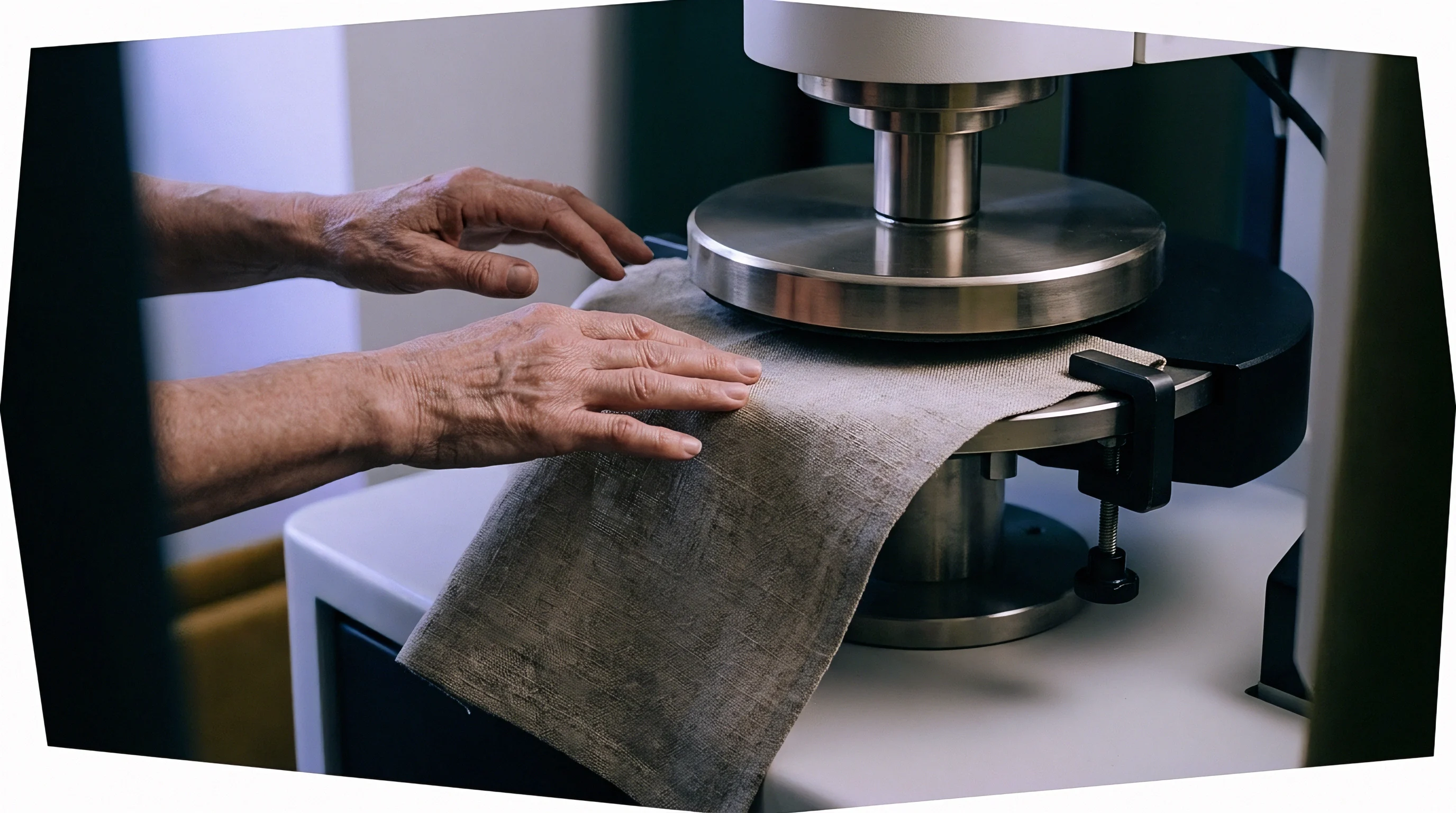
Wet spinning troughs run at 60°C to 75°C to soften the intercellular calcium pectate matrices holding elementary flax fiber bundles together. Pectin sits within the middle lamella of the flax stem, serving as the main structural binder between cortical fiber cells. As roving enters the hot water bath directly above the drafting zone, heat and fluid flow break down water-insoluble protopectin into soluble pectinic acid and galacturonan polymers.
This dissolution lets individual ultimate fibers slide past each other during drafting, yielding fine, uniform yarns that dry spinning cannot produce.
Dissolving these non-cellulosic fractions releases organic matter into the trough and immediately cuts roving dry mass. Pectin extraction loss typically accounts for 2.5 percent to 5.5 percent of initial dry fiber weight. Over-retted green flax shows higher soluble loss, whereas dew-retted or under-retted fiber retains more calcium bridges.
Calcium ions in hard process water act as cross-linking agents that suppress pectin solubility, whereas soft or acidic water accelerates extraction and drives up immersion mass loss.
Trough retention time governs the depth of chemical leaching throughout the fiber bundle. Roving linear density, twist factor, flyer speed, and bath immersion path length establish this duration, which generally falls between 3.0 and 6.5 seconds. Higher bath temperatures lower water viscosity and open up the fiber matrix, allowing water to reach the core of heavier roving strands.
Excessive heat, however, hydrolyzes structural hemicellulose, degrading yarn tenacity and loading mill effluent with dissolved organic carbon.
Water trough immersion at 70 degrees Celsius for 4.5 seconds dissolves 3.6 percent of total dry rove mass through pectin solubilization.

Operational Vectors of Unrecorded Fiber Mass Reduction
Mass loss in the water trough stems from several distinct chemical and physical mechanisms. Technical audits track each vector separately to distinguish true pectin dissolution from mechanical fiber shed or chemical degradation.
- Protopectin Hydrolysis solubilizes galacturonic acid chains under thermal stress, removing 1.8 percent to 3.2 percent of dry bundle mass.
- Calcium Pectate Dissociation breaks divalent ion cross-links in soft water environments, releasing short-chain pectic substances.
- Hemicellulose Leaching targets amorphous xylan and glucan fractions, contributing up to 1.2 percent of additional mass reduction at temperatures exceeding 72°C.
- Surface Wax Emulsification removes natural lipids at water temperatures above 65°C, reducing fiber lubricant mass by 0.3 percent to 0.7 percent.
- Mechanical Short-Fiber Sloughing detaches unattached micro-fibers into the liquid stream through hydraulic shear forces at the guide rollers.
Turnover rates in the trough shift the concentration gradient between the fiber pore solution and the bulk bath liquor. Static baths saturate quickly, which slows further pectin leaching, whereas continuous water replenishment preserves a steep gradient that maximizes mass loss per second of residence time.
| Bath Temperature (°C) | Residence Time (s) | Water Hardness (ppm CaCO3) | Pectin Loss (%) | Hemicellulose Loss (%) | Total Mass Loss (%) |
|---|---|---|---|---|---|
| 60 | 3.0 | 150 | 1.80 | 0.20 | 2.30 |
| 65 | 4.0 | 100 | 2.40 | 0.45 | 3.15 |
| 70 | 4.5 | 50 | 3.10 | 0.70 | 4.10 |
| 75 | 5.5 | 20 | 3.85 | 1.05 | 5.20 |
| 80 | 6.5 | 10 | 4.40 | 1.40 | 6.10 |
Trough weight loss is sometimes treated as fixed regardless of water turnover, on the assumption that dissolved solids hit saturation equilibrium within thirty minutes of frame startup.


Balance

Gravimetric Reconciliation Principles for Wet Roving Inputs
Calculating net dry mass loss across wet spinning frames requires reconciling bone-dry rove inputs against bone-dry yarn output adjusted for spindle oil pickup. Auditing mill yield fails when calculations depend on conditioned commercial weights. While flax fiber carries an official moisture regain allowance of 12.0 percent, ambient humidity, trough wetting, and package drying create sharp moisture swings between input roving bobbins and output yarn cops.
Auditors isolate non-cellulosic mass loss by sampling roving before and after the wet spinning trough and drying both in a ventilated oven at 105°C ± 2°C until they reach constant weight. Spinning lubricant emulsions applied during drafting or winding introduce non-volatile oil mass to the finished yarn, so the mass balance equation subtracts applied chemical finishes to determine the true pectin extraction loss.
Oven-dry mass determinations eliminate moisture regain distortions when auditing mill fiber yield.

Step-by-Step Gravimetric Loss Audit Protocol
Measuring pectin extraction loss accurately requires following a strict sampling protocol across active spinning frames.
- Cut a ten-meter strand of roving directly above the trough inlet guide, place it immediately in a sealed vapor-tight container, and record the wet gross mass.
- Dry the rove sample in a forced-draft oven at 105°C for four hours until consecutive weighings spaced fifteen minutes apart differ by less than 0.05 percent.
- Record the bone-dry rove mass (Mr).
- Doff the corresponding spun yarn package from the spindle after ten minutes of continuous running, unwind a ten-meter length, extract spinning finish oils using petroleum ether in a Soxhlet apparatus, and dry the residual yarn at 105°C to constant mass.
- Record the bone-dry, solvent-extracted yarn mass (My).
- Calculate the percentage pectin extraction loss (Lp) using the relation: Lp = ((Mr – My) / Mr) × 100.
Relying on unadjusted weighings introduces errors of up to 8 percent into final yield calculations, obscuring physical fiber losses or overstating chemical dissolution rates.
Worked Example of Extraction Loss and Yield Calculation
An audit of a wet spinning line processing a 1,000 kg batch of European Flax roving declared at a nominal linear density of 0.80 ktex (Nm 1.25) evaluated production of Nm 26 spun yarn (38.46 tex). The mill declared a mechanical spinning waste rate of 2.0 percent and an extraction loss of 3.5 percent.
Verifying these parameters requires oven-dry mass balance equations. At 12.0 percent moisture regain, the input batch contains 892.86 kg of bone-dry flax fiber. Five sampled roving bobbins averaged a bone-dry mass of 0.792 grams per meter (Mr).
Spun yarn samples taken from the matching spindles, after solvent extraction of 0.80 percent spinning lubricant, averaged 0.0369 grams per meter bone-dry (My). At a mechanical draft ratio of E = 20.80, the expected yarn mass per meter without chemical loss comes to 0.792 / 20.80 = 0.03808 grams per meter.
The actual pectin extraction loss is calculated as:
Lp = ((0.03808 – 0.0369) / 0.03808) × 100 = (0.00118 / 0.03808) × 100 = 3.10%
The measured extraction loss is 0.40 percentage points lower than the mill’s declared 3.50 percent. On an annual volume of 500 metric tonnes of certified fiber, that 0.40 percent variance equals 2,000 kg of unverified mass loss. Inflating extraction losses allows operations to conceal short shipments, unrecorded fly waste, or the introduction of uncertified secondary flax.
When pectin dissolution is not separated from mechanical drafting waste, yield metrics are distorted, leaving buyers paying pure fiber rates for dissolved organic solids lost down the mill drain.

Attenuation
Yarn Linear Density Shift and Draft Ratio Corrections
Ring frame draft gearing adjustments must account for the mass lost as flax passes through the hot water bath. Mass reduction in the trough directly lowers the linear density of the strand feeding the drafting zone. If 0.80 ktex roving loses 4.0 percent of its dry mass during immersion, its effective linear density at the front delivery roller falls to 0.768 ktex.
Leaving the mechanical draft unchanged causes the delivered yarn to run significantly finer than specified.
Spinning mills change draft gear train wheels to compensate for this loss of roving mass. Producing Nm 26 yarn from roving that loses 4.0 percent of its mass to pectin extraction requires reducing the mechanical draft ratio by 4.0 percent relative to theoretical dry calculations.
High calcium concentration in trough immersion water preserves intercellular pectin matrix and demands higher bath temperatures for effective drafting.

What Extraction Allowance Corrects Yarn Linear Density?
Auditors use target yarn linear density equations that incorporate measured pectin extraction loss to ensure delivered yarns fall within ISO 2060 count tolerances.
Draft calculations are adjusted by applying the extraction correction factor (Fe) to the nominal draft formula. The true draft ratio (Etrue) relates to mechanical draft (Emech) and extraction loss percentage (Lp) as:
Etrue = Emech × (1 – (Lp / 100))
When higher trough temperatures increase pectin extraction, yarn count turns finer. Operators must drop draft gear teeth to build up strand thickness and keep yarn linear density within commercial limits.
| Nominal Rove (ktex) | Target Yarn Count (Nm) | Theoretical Draft | Pectin Loss (%) | Adjusted Draft Ratio | Uncorrected Yarn Count (Nm) |
|---|---|---|---|---|---|
| 0.80 | 26.0 | 20.80 | 2.50 | 20.28 | 26.67 |
| 0.80 | 26.0 | 20.80 | 3.50 | 20.07 | 26.94 |
| 0.80 | 26.0 | 20.80 | 4.50 | 19.86 | 27.23 |
| 0.80 | 26.0 | 20.80 | 5.50 | 19.66 | 27.51 |
Control Criteria for Wet Spinning Frame Auditing
Auditing wet spinning operations requires examining frame operating parameters to verify stable fiber attenuation and consistent mass balance reporting.
- Trough Thermal Stability requires continuous multi-point digital temperature monitoring to limit temperature fluctuations within ±1.5°C across all spinning frames.
- Liquor Refresh Volume dictates that automated dosing valves maintain continuous water flow between 1.2 and 1.8 liters per spindle per hour.
- Draft Gear Verification involves checking physical gear tooth counts against production order change cards to confirm compensation for pectin mass loss.
- Effluent Total Dissolved Solids tracking ensures online conductivity sensors flag sudden spikes in dissolved organic matter.
Over-retted flax dissolves rapidly when exposed to high bath temperatures, reducing yarn strength and making detailed audit logs essential for verifying process control.
Commercial spinning rooms continue to debate whether dynamic pectin leaching rates vary predictably across different retting harvests in the absence of continuous online refractometer monitoring.

Bench

Laboratory Extraction Protocols for Fiber Chemical Verification
Laboratory verification of pectin loss pairs gravimetric ammonium oxalate extractions with spectrophotometric galacturonic acid assays. Mill-floor gravimetric checks show total mass loss, but cannot differentiate between pectin dissolution, wax emulsification, and hemicellulose breakdown. Bench testing separates these fractions to evaluate mill declarations directly.
A 0.5 percent ammonium oxalate solution selectively chelates calcium ions bound within pectinates, dissolving protopectin without breaking down structural alpha-cellulose. Boiling flax roving in 0.5 percent ammonium oxalate for two hours at a 1:50 liquor ratio extracts both soluble and insoluble pectin fractions. The remaining residue is rinsed with deionized water, dried at 105°C, and weighed, with the mass difference reflecting total pectin content.
Spectrophotometric testing applies the m-hydroxydiphenyl method to measure galacturonic acid in the trough liquor. Hydrolyzing bath samples with concentrated sulfuric acid containing sodium tetraborate yields galacturonic acid monomers, which turn pink upon adding m-hydroxydiphenyl reagent, reaching peak absorbance at 520 nm. Comparing absorbance against a standard D-galacturonic acid calibration curve gives absolute pectin concentration in milligrams per liter of effluent.
European Flax Chain of Custody Standard section 4.2 mandates a documented mass reduction factor for wet spinning hot water bath extraction.

Analytical Protocol Comparison Matrix
Selecting an analytical verification method depends on the needed precision, turnaround time, and available lab equipment.
| Test Protocol | Primary Analyte | Accuracy (%) | Test Duration | Equipment Requirement |
|---|---|---|---|---|
| Ammonium Oxalate Extraction | Total Pectin Content | ±0.15 | 3.5 Hours | Reflux Condenser, Drying Oven |
| m-Hydroxydiphenyl Assay | Galacturonic Acid | ±0.05 | 1.5 Hours | UV-Vis Spectrophotometer |
| Gravimetric Soxhlet Extraction | Surface Waxes and Fats | ±0.10 | 5.0 Hours | Soxhlet Extraction Unit |
| Enzymatic Pectinase Hydrolysis | Water-Soluble Pectin | ±0.08 | 2.0 Hours | Incubator, HPLC Unit |
| Muffle Furnace Ashing | Bound Calcium Pectates | ±0.20 | 4.0 Hours | Muffle Furnace (550°C) |

Quality Verification Workflow for Mill Process Effluent
Auditors sample fluid directly from the spinning frame trough drains to establish dissolved organic carbon profiles.
- Sample Clarification requires passing raw bath fluid through a 0.45-micron PTFE syringe filter to remove floating micro-fibers.
- Acid Precipitation involves adding ethanol to the filtrate at a 1:4 volume ratio to precipitate high-molecular-weight pectin polymers for dry weighing.
- Divalent Cation Titration measures depletion of free calcium ions in process water to calculate the rate of calcium pectate cross-link cleavage.
- Ash Content Analysis combusts dry residue at 550°C in a muffle furnace to determine mineral salt proportions bound within extracted pectic substances.
A sharp drop in trough effluent turbidity points to incomplete pectin softening, indicating that yarn strength variation will increase across subsequent bobbin layers.

Ledger
Mass Balance Reconciliation in Certified Supply Chains
Mass balance certificates issued under European Flax or GOTS standards require accounting for non-cellulosic processing losses. Transaction Certificates (TCs) record physical fiber volumes moved between supply chain partners. When a spinning mill purchases 100 metric tonnes of certified green flax roving, wet spinning cannot output 100 metric tonnes of yarn.
Mechanical waste accounts for 2.0 percent to 3.5 percent of fiber loss, and hot water pectin extraction removes an additional 2.5 percent to 5.5 percent of dry mass.
Auditors review transaction documentation to confirm that certified output mass equals certified input mass minus recorded processing losses. Reporting a 1:1 conversion ratio between roving input and yarn output breaches mass balance rules. Unreported pectin extraction creates an artificial volume gap, which mills sometimes offset by blending non-certified secondary fiber while billing customers under certified claims.
Certifier scope audits check mill conversion factors against laboratory gravimetric test reports, applying the standard twelve percent regain allowance. When a mill reports an extraction loss outside the benchmark range of 2.5 to 5.0 percent, certifiers require full gravimetric frame testing before releasing transaction certificates for downstream shipments.

Commercial Weight Adjustments and Invoice Calculations
Commercial contracts for wet-spun flax yarn include explicit terms for pectin extraction loss and moisture regain adjustments. Raw fiber purchase agreements set payment based on conditioned weight calculated from oven-dry mass plus standard regain allowances. For wet-spun yarn contracts, buyers price deliveries on clean dry cellulose content plus standard regain, excluding dissolved pectin mass from the payable weight.
When audits reveal an under-reported extraction loss, commercial price adjustments are applied retroactively across delivered bobbin lots. Contract terms define allowable tolerances for yarn linear density, extraction loss percentages, and residual pectin levels; exceeding these limits prompts price deductions or lot rejections under trade rules.
European Flax Chain of Custody Standard section 4.2 mandates a documented extraction allowance between 2.5 percent and 5.0 percent for wet-spun flax yarns, reclassifying unmeasured mass discrepancies as uncertified fiber substitution.