Substantial Transformation Audits in Multi-Country Linen Supply Chains
Substantial transformation audits in multi-country linen supply chains require linking lot-level transaction certificates from European flax fields to Asian spinning and weaving facilities to satisfy customs origin rules.


Dock
Cross-border commercial shipments of linen goods meet regulatory scrutiny at the point of import, where declared origin dictates applicable customs duties, trade preference eligibility, and retaliatory tariff exposure. Customs authorities in major destination markets examine the physical movement of materials alongside declared Harmonized System classifications to establish non-preferential country of origin. Raw flax straw harvested in Western Europe regularly undergoes primary processing in one jurisdiction, spinning in a second, weaving in a third, and final cut-and-sew assembly in a fourth.
This multi-stage dispersion requires applying legal substantial transformation standards directly rather than relying on brand claims or commercial invoices.

Tariff Shifts across International Entry Points
Determining non-preferential origin for textile products under United States regulations follows the specific rules set forth in 19 CFR 102.21. Customs authorities apply a hierarchical methodology to identify which manufacturing stage confers origin. Unprocessed flax fibre classified under heading 5301 enters intermediate processing facilities as raw, retted, or scutched material.
Converting raw flax fibre into single or multiple linen yarn under heading 5306 constitutes a substantial transformation under both United States and European Union customs frameworks, as the process alters the fundamental character, commercial name, and four-digit tariff classification of the input fibre.
When yarn spun in one country moves to another for fabric formation, weaving under heading 5309 confers fabric origin under most international non-preferential frameworks. Table 1 outlines the regulatory thresholds and tariff heading transitions governing linen goods across key importing jurisdictions.
| Processing Stage | Input HS Code | Output HS Code | US Customs 19 CFR 102 Rule | EU UCC Article 60 Criterion |
|---|---|---|---|---|
| Scutching and Hackling | 5301.10 | 5301.21 | No origin change; primary agricultural processing | Origin stays with cultivation harvest state |
| Yarn Spinning | 5301.21 | 5306.10 | Tariff shift to 5306 confers yarn origin | Last substantial economic processing confers origin |
| Fabric Weaving | 5306.10 | 5309.11 | Tariff shift to 5309 confers fabric origin | Weaving operation confers fabric origin |
| Bleaching and Dyeing | 5309.11 | 5309.19 | Finishing alone fails to confer fabric origin | Minor processing; no origin change conferred |
| Cut and Sew Assembly | 5309.19 | 6302.21 | Assembly confers origin for made-up bed linen | Complete assembly confers final article origin |
Non Preferential Origin Criteria for Linen Goods
European Union customs authorities apply Article 60 of Regulation 952/2013, known as the Union Customs Code, to evaluate multi-country processing. Non-preferential origin belongs to the country where the goods underwent their last substantial, economically justified processing in a facility equipped for that purpose. For woven linen fabrics, weaving represents the critical manufacturing step.
If an importer brings raw European scutched flax into a spinning mill in China, the resulting yarn carries Chinese origin for non-preferential customs declarations. Importing that yarn into Vietnam to weave grey cloth assigns Vietnamese origin to the unbleached fabric. Import declarations entering European or American ports must reflect these physical processing locations, regardless of where the original flax was grown.
Western European scutched flax yields average 18 percent long fibre and 12 percent tow fibre by gross unretted straw weight.
Confusing preferential origin rules with non-preferential origin rules presents substantial legal risk to importers. Preferential trade agreements demand specific localized content percentages or double-transformation hurdles, such as requiring both spinning and weaving within agreement territory. Non-preferential origin dictates country-of-origin marking and baseline tariff rates.
An audit on imported bed linen classified under heading 6302 verifies whether cut-and-sew assembly actually occurred in the declared country or whether flat goods were merely hemmed in a transitional facility to bypass higher tariff rates.
Commercial purchase contracts must specify that origin declarations rely on objective manufacturing criteria verified by local customs entry documentation rather than vendor assertions.


Draft
Converting scutched flax fibre into spun yarn involves mechanical hackling, drafting, sliver blending, and spinning. Long flax fibres undergo hackling to align strands and remove short residues, producing combed sliver suitable for high-count wet spinning. Short fibres separate into tow, which feeds dry spinning lines for coarse yarns.
Wet spinning passes hackled sliver through 60 degrees Celsius hot water baths to soften pectin binders before drawing and twisting, achieving dense, smooth yarns. Dry spinning bypasses thermal softening, producing loftier, less uniform yarns intended for heavy structural fabrics.

Spinning Mechanics and Fiber Transformation Yields
Mass yield during spinning directly impacts traceability audits. Scutching yield figures averaging 18 percent long fibre reflect Western European dry-retted straw harvested under 12 percent stem moisture; wet weather during field retting drops this yield to 14 percent while raising tow production. Hackling long fibre generates approximately 60 percent hackled line sliver and 35 percent hackling tow, leaving 5 percent invisible waste.
Wet spinning long-line sliver yields finished yarn at a ratio of roughly 0.92 kilos of yarn per kilo of input sliver due to pectin loss and fly waste.
Audit reconciliation tracks bale lot tags from the raw fibre warehouse through sliver drafting frames. Chinese ring-spinning mills processing imported European fibre maintain daily production registers that map specific raw fibre bale codes to output yarn lot numbers. Auditors check these registers against weighbridge receipts and carding logs to confirm that declared European fibre volumes match physical yarn output.

Mass Balance Verification in Yarns
Reconciling input fibre against output yarn prevents uncertified substitution. When a mill buys 100 metric tonnes of European Flax certified scutched fibre, the facility must account for process losses across every mechanical stage. Uncertified short-staple flax or cotton fibre introduced during sliver drafting alters the blend composition and breaks the chain of custody.
- Confirm gross mass of arriving raw flax bales against bill of lading weights and weighbridge tickets at the spinning mill receiving dock.
- Inspect bale markers, lot numbers, and physical tags to match batch identifiers against the seller scope certificate and transaction certificate.
- Calculate expected long-line sliver yield using a baseline 60 percent hackling recovery factor adjusted for moisture content.
- Audit daily sliver drawing logs to ensure certified long-line sliver processes on designated frames without intermixing uncertified tow stocks.
- Reconcile total weight of spun yarn lot against calculated maximum theoretical yield plus permitted mill waste allowances.
Discrepancies exceeding 3 percent between theoretical yarn output and physical yield signal unrecorded raw material substitution or untracked blending with lower-grade fibre. Spinning mills that fail to segregate certified lots risk invalidating the transaction certificates required for downstream substantial transformation claims.
Unrecorded moisture variations occurring during ocean transit between European ports and Asian spinning facilities account for yield anomalies.


Proof
Documentary chains of custody establish whether fibre provenance claims survive multi-country manufacturing steps. Scheme scope documents define which production phase a certifier validates and what processing boundaries apply. European Flax certification validates raw fibre grown exclusively in Western Europe, specifically France, Belgium, and the Netherlands.
This certification covers agricultural harvesting, retting, and scutching. When European Flax certified fibre exports to spinning mills in Asia, the certification travels with the material under a transaction certificate system to guarantee fibre origin, without certifying that yarn spinning or fabric weaving occurred in Europe.
Masters of Linen represents a stricter processing scope. Masters of Linen mandates that every transformation step, including flax cultivation, scutching, yarn spinning, and fabric weaving, occurs entirely within European territory. A Chinese or Vietnamese mill cannot produce Masters of Linen fabric, even if the facility buys 100 percent European Flax certified raw fibre.
OEKO-TEX Standard 100 tests finished textiles for harmful chemical residues to certify safety compliance, but provides zero proof regarding geographic origin or raw material provenance.
| Scheme Name | Covered Life Cycle Stages | Geographic Restrictions | Chain of Custody Model | Customs Origin Proof Value |
|---|---|---|---|---|
| European Flax | Straw, Scutching, Hackling | Western Europe for growing | Physical segregation or Mass balance | Proves raw material origin only |
| Masters of Linen | Field to Finished Woven Fabric | 100 percent European Union | Strict physical segregation | Proves total European origin |
| Global Organic Textile Standard | Ginning, Spinning, Weaving, Dyeing | Global compliance | Transaction certificates per lot | Proves organic process; not origin |
| OEKO-TEX Standard 100 | Chemical Finishing, Finished Article | Global compliance | Finished product testing | Zero geographic origin value |

Certification Schemes and Scope Boundaries
Audit failures frequently trace to confusion between Scope Certificates and Transaction Certificates. A Scope Certificate confirms that an independent certifier inspected a facility and verified its operational capacity to process certified goods under ISO 17065 standards, but it does not prove that a specific shipment contains certified fibre. Transaction Certificates provide lot-by-lot proof.
Issued by accredited certification bodies, a Transaction Certificate details the exact net weight, lot numbers, invoice references, and shipping dates for the specific material transferred from seller to buyer.
Auditing a multi-country linen chain requires linking sequential Transaction Certificates without gaps. The Transaction Certificate from the European scutcher to the Asian spinning mill must match the input volume recorded on the certificate issued by the spinner to the fabric weaver. A gap anywhere in the chain invalidates downstream provenance claims, exposing the buyer to regulatory penalties for false origin declarations.
Section 304 of the Tariff Act of 1930 imposes a ten percent ad valorem marking duty on textile imports lacking clear origin documentation at entry.

Transaction Certificate Audit Protocols
Independent third-party auditors conduct on-site and remote reviews of mill accounting logs to confirm that incoming certified fibre volumes balance outgoing certified products. Auditors scrutinize mass loss calculations, waste recovery streams, and subcontracted processing operations. Subcontracting wet processing or pirn winding to uncertified facilities breaks the physical chain of custody unless the subcontractor operates under an explicit scope extension.
- Expired Scope Certificates represent a critical compliance failure where processing occurs after an audit certificate expires but before annual renewal verification completes.
- Volume Balance Discrepancies indicate that outgoing certified yarn weights exceed verified incoming raw fibre allocation after accounting for standard spinning waste rates.
- Missing Transaction Certificates occur when intermediate vendors ship goods using standard commercial invoices without obtaining lot-specific transfer documents from their certifier.
- Unregistered Subcontractors emerge when spinning or weaving mills outsource sizing, twisting, or bleaching to uncertified external plants without customer authorization.
- Commingled Storage Records show raw certified fibre bales stored alongside conventional fibre without physical barriers or clear batch identification tags.
Container shipping lines transport raw flax fibre across high-humidity oceanic routes, altering material weight through moisture absorption during passage. When a shipment gains two percent water weight in transit, questions arise over whether the downstream mill calculates its mass balance audit against net dry weight or billed landed weight.

Loom
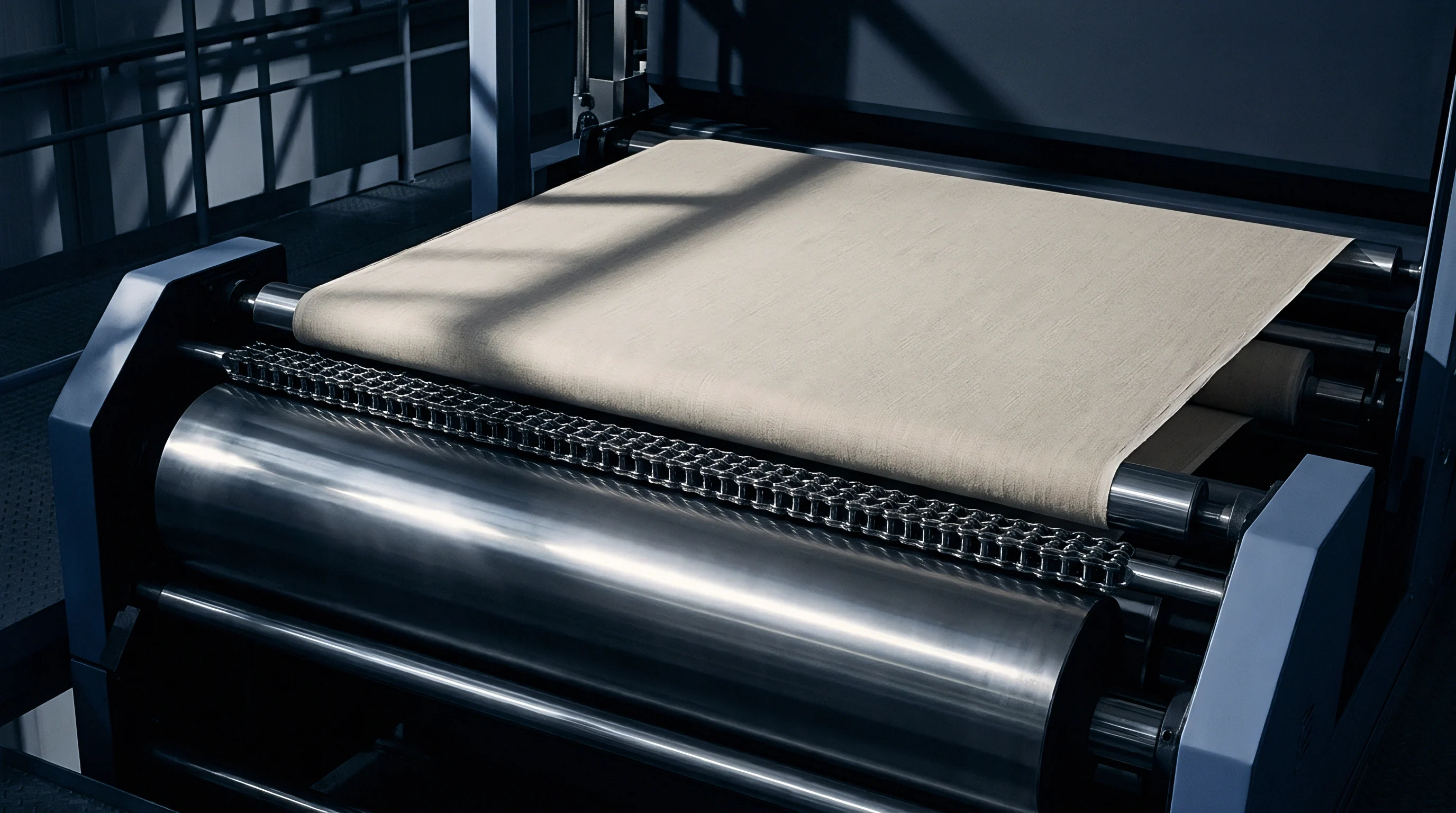
Weaving transforms spun linen yarn into structural greige fabric on high-speed rapier or air-jet looms. Warp yarns undergo sizing with starch or synthetic polymers to increase tensile strength and resist abrasion during shedding. Shuttleless weaving inserts weft yarns through the warp shed, producing grey cloth defined by warp count, weft count, and fabric weight per square metre.
Under international trade regulations, weaving constitutes the primary manufacturing phase assigning non-preferential country of origin to woven textile fabrics.

Does Finishing Alone Confer Origin on Greige Fabric?
Finishing greige fabric through bleaching, mercerization, dyeing, printing, or soft-washing alters the physical appearance and hand of linen cloth without changing its fundamental customs origin. Importing grey woven fabric from China into Vietnam for piece dyeing and soft-washing leaves non-preferential origin with China under United States 19 CFR 102.21 rules. Dyeing and finishing operations fail to fulfill the requirement for a four-digit tariff heading shift when input and output goods remain classified under heading 5309.
European Union customs rules under UCC Delegated Regulation 2015/2446 apply specific process-based criteria. Dyeing or printing unbleached woven fabric confers origin only if accompanied by two or more preparatory or finishing operations ~ such as desizing, mercerizing, tentering, or preshrinking ~ and provided the value added exceeds a specified percentage of the ex-works price. Failing to meet these strict process rules leaves origin with the country where the fabric was woven.
Finishing processes changing color or hand fail to shift customs origin without a concurrent change in four-digit tariff heading.

Weaving and Assembly Rules in Multi Country Chains
Converting finished fabric into completed articles like bed sheets, tablecloths, or apparel represents the final phase of multi-country supply chains. Under United States rules for made-up textile articles classified in Chapter 63, cut-and-sew assembly confers origin if all outer fabric components are cut and sewn in a single jurisdiction. Hemming flat woven fabric imported as rolls does not confer origin; origin stays with the fabric weaving location.
| Process Stage | Standard Mass Loss Factor | Allowable Variance Range | Primary Waste Stream |
|---|---|---|---|
| Hackling and Combing | 35.0 percent | 32.0 to 38.0 percent | Short tow fibres, dust |
| Wet Ring Spinning | 8.0 percent | 6.5 to 9.5 percent | Pectin sludge, fly waste |
| Warp Sizing and Winding | 2.5 percent | 1.5 to 3.5 percent | Yarn ends, sizing buildup |
| Rapier Fabric Weaving | 3.5 percent | 2.5 to 5.0 percent | Fringe selvage, cut ends |
| Bleaching and Mercerizing | 5.0 percent | 4.0 to 6.5 percent | Soluble sizing, lint wash |
Weaving waste allowance figures of 3.5 percent rest on high-speed rapier loom records using sized wet-spun yarns; shuttleless air-jet looms running unsized tow yarns push waste past 5.8 percent due to higher yarn breakage rates. Auditors verifying weaving records reconcile total yarn purchase weights against finished greige fabric roll weights plus recorded loom waste.
- Greige Loom Records document daily machine allocations, fabric style numbers, total pick counts, and physical roll weights produced per shift.
- Sizing Removal Certificates record chemical treatment metrics, desizing weight loss percentages, and batch wash recovery figures.
- Subcontract Dye House Receipts confirm fabric dye lot numbers, process chemical logs, and piece-dyed yardage yields returned to the primary facility.
- Cut and Sew Master Markers detail pattern cutting efficiency, fabric consumption per unit, and trim waste percentages generated during assembly.
Fabric weavers maintaining segregated storage racks keep greige rolls tagged with yarn lot codes to ensure origin trace integrity prior to wet processing.
Claim
Executing commercial transactions for certified European linen processed in multi-country supply chains carries explicit financial premiums. Certified European Flax raw fibre carries a price surcharge ranging from 15 to 30 percent over conventional uncertified flax fibre of equivalent staple length and grade. Processing certified fibre through Asian spinning and weaving mills introduces administrative audit costs, third-party certification fees, and batch segregation expenses that add 0.20 to 0.45 Euros per linear metre of finished grey cloth.
Financial Surcharges and Landed Cost Arithmetic
Landed cost calculations must reflect both raw material surcharges and document execution fees. An importer ordering 20,000 metres of 200 gram-per-square-metre woven linen fabric absorbs specific cost elements across the supply chain, where uncertified blending risks threaten total capital investment if customs authorities seize non-compliant shipments.
The global blend-contamination rate in unsorted Chinese bale stores fluctuates between 4 percent and 11 percent depending on mill location; buyers manage this variance by requiring batch-level DNA marker sampling or mandating physical isolation of certified European fibre lines. If a customs audit identifies falsified origin claims or broken transaction chains, authorities can issue redelivery notices, assess 100 percent marking penalties, or confiscate the shipment entirely.
Audit trails break when spinning mills commingle certified European fibre with uncertified domestic stock in open-end yarn lines.

Contractual Origin Warranties and Risk Allocation
Sourcing practices manage regulatory and provenance risks by inserting explicit contractual warranties into mill purchase agreements. Boilerplate clauses declaring goods compliant with local laws offer little protection against customs audits. Standard procurement contracts require modification to shift financial liability for audit failure directly onto the seller.
Contracts must state that the seller warrants full traceability of raw materials from accredited cultivation through final fabrication, supported by sequential Transaction Certificates issued under ISO 17065 accredited schemes. The agreement must mandate that the seller reimburses the buyer for all direct customs penalties, legal fees, freight demurrage, and lost commercial margin resulting from invalid origin declarations or broken certification chains.
Failing to verify transaction scope parameters prior to issuing purchase orders leaves importers fully exposed to customs enforcement actions and severe reputational damage when mislabeled goods reach commercial markets.