Quantifying Bast Fiber Lignin Content for Mill Sourcing
Klason lignin testing combined with wet spinning draft analysis establishes raw flax mill suitability and prevents costly frame end breaks.


Lamella
In bast plants, complex aromatic polymers concentrate within the intercellular spaces separating individual fiber strands, where lignin anchors the bundle structure. These fibers exist naturally as composite bundles in the phloem tissue of annual or perennial dicotyledonous crops such as flax, hemp, jute, and ramie. Individual elementary fibers, measuring 10 to 40 millimeters in length and 10 to 25 micrometers in diameter, are bound into long technical fiber bundles by a non-cellulosic matrix of pectin, hemicellulose, and lignin.
Botanical Distribution and Phenolic Architecture
Phenolic compounds are distributed unevenly across the cross-section of a bast fiber. The highest concentration occurs in the middle lamella, where lignin fractions exceed 25 percent by weight of the local tissue. Within the primary cell wall, lignin forms a rigid matrix interpenetrating amorphous regions of hemicellulose.
The secondary wall, composed mostly of highly crystalline cellulose arranged in microfibrils with low angles between 6 and 10 degrees, contains far lower lignin concentrations, typically below 1.5 percent.
Bast fiber lignin is constructed from three phenylpropanoid monomeric units: guaiacyl (G), syringyl (S), and p-hydroxyphenyl (H) units, derived respectively from coniferyl alcohol, sinapyl alcohol, and p-coumaryl alcohol. Flax lignin exhibits a G-rich composition with moderate S-unit inclusion, yielding a monomeric G:S:H ratio near 75:20:5. Hemp lignin carries higher S-unit proportions ~ up to 35 percent ~ which yields a less branched, more linear polymer structure.
Covalent linkages, including phenylcoumaran (beta-5) and ether (beta-O-4) bonds, cross-link these phenolic units to structural hemicellulose chains via ferulic acid ester bridges.
Retting Kinetics and Chemical Cleavage
Microbial activity during dew or water exposure selectively hydrolyzes pectins and hemicelluloses, softening the intercellular matrix and allowing technical fibers to separate from the surrounding woody core shive. Controlled microbial degradation lowers total matrix content without compromising the structural integrity of the technical fiber. Dew retting relies on field fungi, primarily Cladosporium herbarum, which secrete pectinases and hemicellulases under ambient moisture and temperature fluctuations.
Water retting employs anaerobic bacteria, predominantly Clostridium acetobutylicum, to execute rapid pectin degradation in warm water basins.
Under-retting leaves excessive pectin-lignin complexes in the middle lamella, producing stiff, broad technical bundles that resist division during hackling. Over-retting permits cellulolytic enzymes to penetrate the primary cell wall, hydrolyzing cellulose chains, reducing the degree of polymerization, and causing severe loss of tensile strength. Residual lignin content serves as a precise indicator of retting progress.
Unretted flax straw contains between 4.5 and 6.5 percent total lignin by weight. Successfully retted long-line flax carries residual Klason lignin levels between 1.8 and 2.5 percent, whereas industrial hemp leaves residual levels between 3.5 and 6.0 percent due to higher initial lignification in the phloem tissue.
The non-cellulosic matrix in bast fiber middle lamellae requires controlled enzymatic cleavage to reduce technical fiber diameter without compromising single-fiber tensile strength.
Chemical retting processes employing sodium hydroxide, chelating agents such as ethylenediaminetetraacetic acid (EDTA), or commercial pectinase enzyme formulations accelerate matrix breakdown. Alkaline extraction at elevated temperatures removes amorphous hemicelluloses and ester-linked phenolic acids, yet leaves core lignin structures intact unless severe cooking conditions are applied. The target residual lignin fraction depends directly on the intended spinning technology.
Wet spinning requires low lignin levels to facilitate aqueous drafting, whereas dry spinning accepts higher lignin fractions that provide bundle stiffness and bulk in heavier yarn counts.
Retting duration directly controls the ratio of insoluble to soluble phenolics remaining on the fiber surface. Extended dew exposure in wet climates causes fungal hyphae to consume cell wall polysaccharides, shifting the relative lignin percentage upward while reducing absolute bundle mass. Mill buyers monitoring retting quality measure total lignin alongside water-soluble extractables to ensure structural polysaccharides remain intact before issuing purchasing approvals for high-count yarn processing.
Lower residual lignin content yields finer technical fiber bundles, provided the cellulolytic core of the elementary fibers remains untouched by fungal degradation during retting.

Assay
Laboratory quantification of phenolics in plant tissue requires precise separation of cellular constituents. Test methods evaluate distinct chemical fractions, causing variance between reported values on mill analytical certificates. Selecting the appropriate quantitative method determines whether incoming fiber lots meet drafting criteria on spinning machines.
Gravimetric Klason and Acid Detergent Procedures
Standardized wet chemistry protocols isolate acid-insoluble fractions using concentrated sulfuric acid digestion. Standard methods TAPPI T 222, ISO 13906, and ASTM E1753 define Klason lignin determination. Fiber samples undergo prior solvent extraction using ethanol-benzene or acetone-water mixtures to remove lipophilic extractables, waxes, and fats that would otherwise precipitate as insoluble residue and artificially inflate the measured lignin percentage.
The extract-free dried fiber undergoes primary hydrolysis in 72 percent sulfuric acid (H2SO4) at 20 degrees Celsius for two hours under constant agitation. Secondary hydrolysis follows by diluting the mixture with distilled water to a 3 percent acid concentration and boiling under reflux for four hours.
Acid-insoluble Klason lignin precipitates out of solution, is collected on a tared glass fiber filter, washed free of sulfate ions, dried at 105 degrees Celsius, and weighed. Acid-soluble lignin remaining in the filtrate requires UV-Vis spectrophotometric measurement at wavelengths of 205 nanometers or 280 nanometers, using an extinction coefficient typical for bast species (approximately 110 liters per gram-centimeter). Combined Klason plus acid-soluble lignin provides total phenolic content.
Acid Detergent Lignin (ADL) protocols, governed by ISO 13906 and AOAC 973.18, utilize cetyltrimethylammonium bromide (CTAB) detergent in 0.5 molar sulfuric acid to strip proteins and cell solubles, isolating Acid Detergent Fiber (ADF). The ADF residue undergoes 72 percent H2SO4 treatment for three hours to dissolve cellulose. Gravimetric determination of the remaining residue yields ADL.
The ADL method yields lower absolute values than Klason protocols because CTAB pre-extraction removes proteinaceous contaminants and acid-soluble phenolic complexes that Klason acid digestion captures as insoluble condensate.

When Does Acid Detergent Lignin Outperform Klason Testing?
High concentrations of extraneous bark and residual core shive alter standard gravimetric measurements. When raw bast fiber shipments contain greater than 2.0 percent shive contamination, the Klason protocol overestimates spinnable fiber lignin content because woody shive tissues carry lignin levels between 22 and 28 percent. Acid Detergent Lignin testing isolates the fibrous wall components more selectively, preventing non-fiber woody fragments from skewing the quality rating of the long-line fiber bundle.
| Analytical Protocol | Standard Designation | Sample Size | Inter-Lab CV % | Soluble Fraction Recovery | Primary Method Interference |
|---|---|---|---|---|---|
| Klason Sulfuric Acid | TAPPI T 222 / ISO 13906 | 1.0 to 2.0 g | 4.2 % | Requires UV-Vis at 205 nm | Protein condensation, residual shive |
| Acid Detergent Lignin (ADL) | AOAC 973.18 / ISO 13906 | 1.0 g | 5.8 % | Excludes soluble phenolics | Incomplete cellulose dissolution |
| Acetyl Bromide (ABSL) | FCBA / Pure Analytical | 5 to 10 mg | 3.1 % | Fully captures dissolved species | Under-derivatization of G-units |
| Attenuated Total Reflectance FTIR | ASTM E168 / Mill Screening | 0.1 g | 7.5 % | Indirect calibration model | Moisture peaks at 1640 cm-1 |
| Methods tested on dew-retted long-line flax at 65% relative humidity and 20°C conditioning according to ISO 6741 standards. | |||||
Spectrophotometric and Instrumental Screening Techniques
Dissolving fiber bundles in acetyl bromide and acetic acid provides rapid optical density measurements. The Acetyl Bromide Soluble Lignin (ABSL) method acetylates hydroxyl groups while brominating alpha-carbon positions, solubilizing the lignin polymer without thermal degradation. Fiber samples weighing 5 to 10 milligrams are treated with 25 percent acetyl bromide in glacial acetic acid at 50 degrees Celsius for two hours, followed by addition of perchloric acid and sodium hydroxide to stop the reaction and remove excess bromine.
Absorbance read at 280 nanometers delivers total lignin content using a specific absorption coefficient of 20.0 liters per gram-centimeter for flax.
Fourier Transform Infrared (FTIR) spectroscopy using Attenuated Total Reflectance (ATR) permits non-destructive mill-gate screening. Calibration models use partial least squares (PLS) regression to map spectral band intensity ratios against wet chemistry Klason values. Key absorption bands include:
- Aromatic Ring Stretch centered at 1505 cm-1 reflecting skeletal vibrations of G and S phenylpropanoid units
- Carbonyl Bond Stretch at 1735 cm-1 capturing acetyl and ester groups present in hemicellulose-lignin linkages
- Guaiacyl Ring Vibe located at 1268 cm-1 indicating C-O stretch in guaiacyl rings
- Cellulose Reference Peak at 1158 cm-1 or 898 cm-1 representing C-O-C asymmetric stretch in glucan chains
Normalizing the 1505 cm-1 peak area against the 1158 cm-1 cellulose reference peak yields an absorbance ratio that correlates directly with Klason percentage. Handheld FTIR units achieve accuracy within plus or minus 0.3 percent lignin when calibrated against homogeneous scutched flax lots.
High gravimetric readings often reflect heavy dew retting character rather than shive inclusion or unretted middle lamella tissue.


Hackle
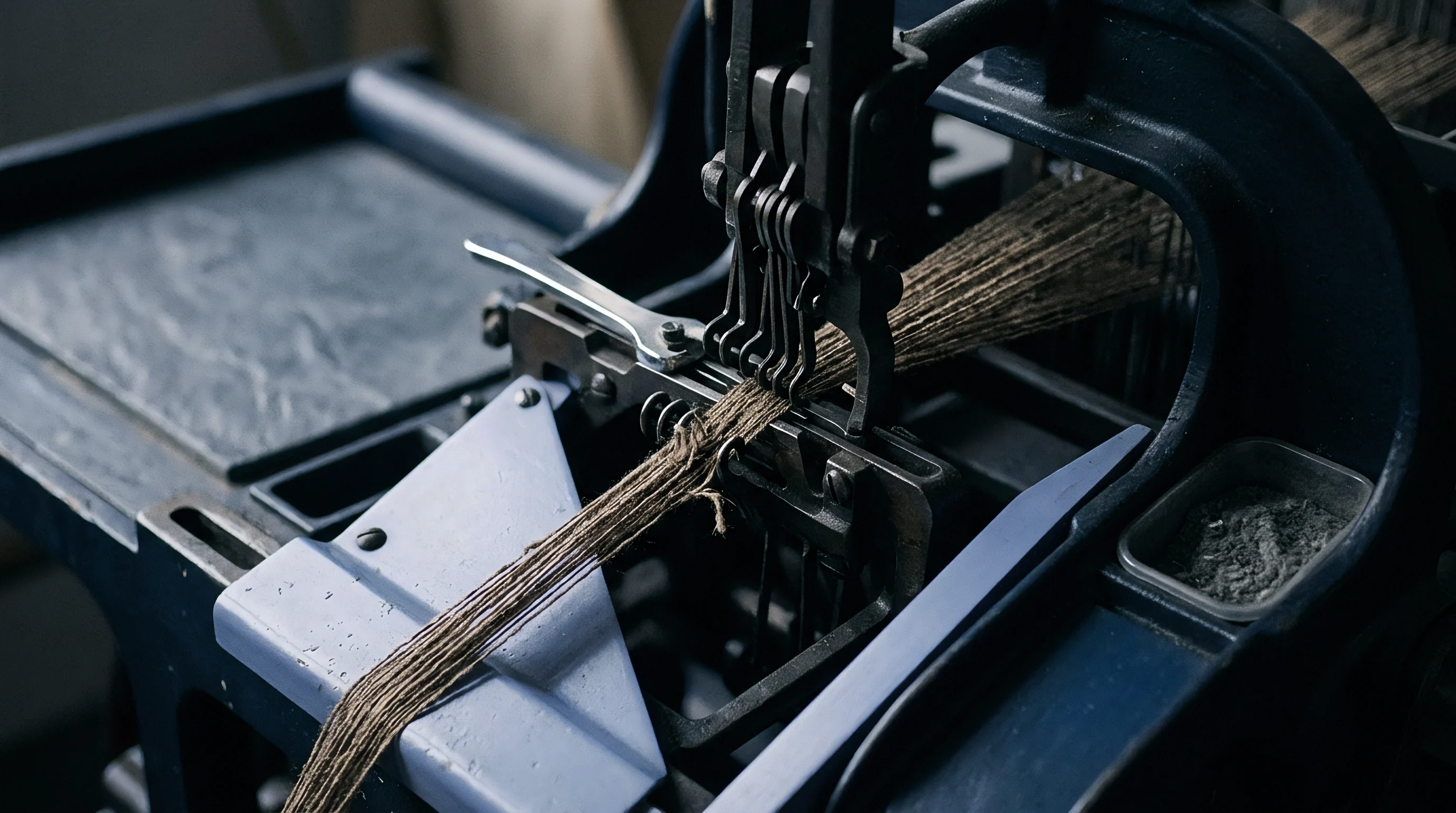
Mechanical pins on comb beds separate raw scutched stricks into parallelized slivers. The density and sharpness of hackling pins exert high mechanical shear forces on incoming fiber bundles, cleaving weak non-cellulosic middle lamella bonds while preserving the length of primary technical strands.

Technical Fiber Splitting and Flexural Rigidity
Individual elementary fibers measure between 10 and 20 micrometers in diameter. Technical fibers formed by bound elementary clusters measure between 50 and 120 micrometers entering the hackling machine. Residual lignin content governs the flexural rigidity of these bundles, directly impacting how cleanly pins split the strick without causing transverse tensile failure.
Bending stiffness scales with the fourth power of technical fiber bundle diameter. When residual Klason lignin exceeds 3.0 percent, high flexural rigidity prevents pins from penetrating into the core of the bundle. The strick behaves as a rigid bar, resisting splitting and breaking under pin impact.
These breakages generate high volumes of short tow fiber, cutting into long-line yield.
Optimal residual lignin between 1.8 and 2.4 percent provides sufficient matrix flexibility for pins to cleave middle lamellae along natural cleavage planes. Technical fiber diameter drops from 80 micrometers down to 30 to 40 micrometers through progressive hackling passes across pin densities increasing from 1 pin per centimeter up to 18 pins per centimeter. Lower lignin content allows complete bundle division down to fine metric counts.
When residual lignin falls below 1.5 percent due to aggressive over-retting, middle lamella cohesion drops below the internal tensile strength of single elementary fibers. Hackling pins cause technical bundles to disintegrate into short, weak elementary fragments. The resulting hackled line lacks cohesion, producing low sliver tenacity and high fly waste in drawing frames.
Hackling yield drops by 3.5 percent for every half-percent increase in residual Klason lignin above the 2.4 percent threshold due to bundle shear breakage on high-density pin beds.

Cohesion Defect Modes in Comb Beds
Deviations from the optimal binding matrix window manifest immediately during mechanical comb passes. High-speed combing subjects fiber stricks to high impact speeds, converting matrix stiffness variations into visible processing defects.
- Shive Entrapment occurs when unretted woody fragments remain bonded to primary bundles via uncleaved lignin-pectin bridges, forcing hackling pins to break whole strands.
- Tow Generation Spikes result from elevated flexural rigidity where stiff bundles snap transversely under pin load rather than splitting longitudinally along middle lamellae.
- Sliver Density Fluctuation emerges from uneven retting along the length of the strick, creating alternating zones of fine split fiber and coarse un-hackled bundle.
- Pin Fouling develops when sticky, partially degraded pectin-lignin complexes migrate to pin tips under frictional heat, causing fiber lap-ups on hackling beds.
Selecting fiber with verified, uniform residual lignin parameters prevents mechanical pin damage, protects hackling yield, and stabilizes sliver weight variation prior to drawing frame passage.
Inconsistent bundle cleavage during early hackling passes transfers un-split technical fibers into the drawn sliver, causing draft waves and count variation during final yarn formation.
Roving
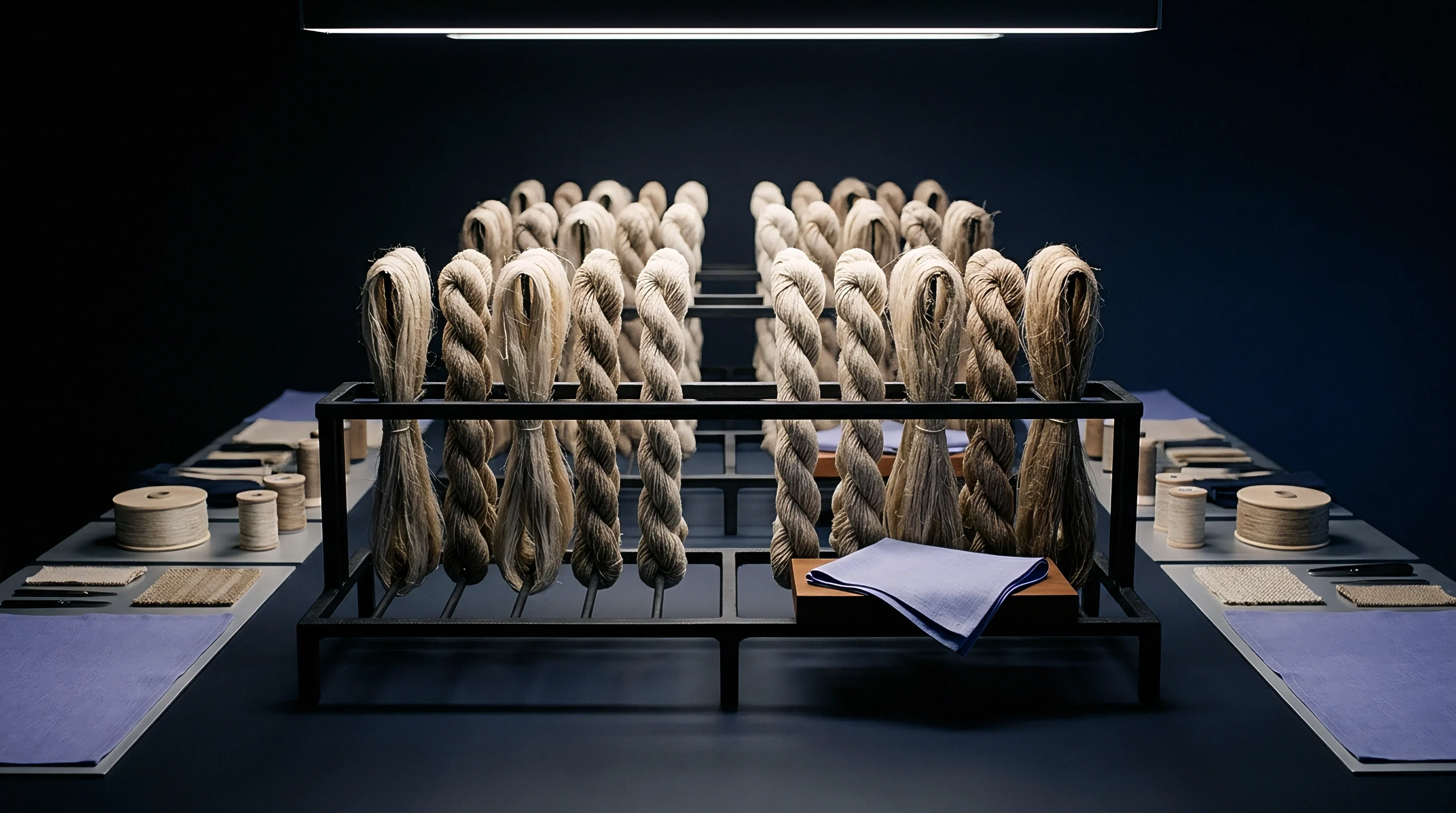
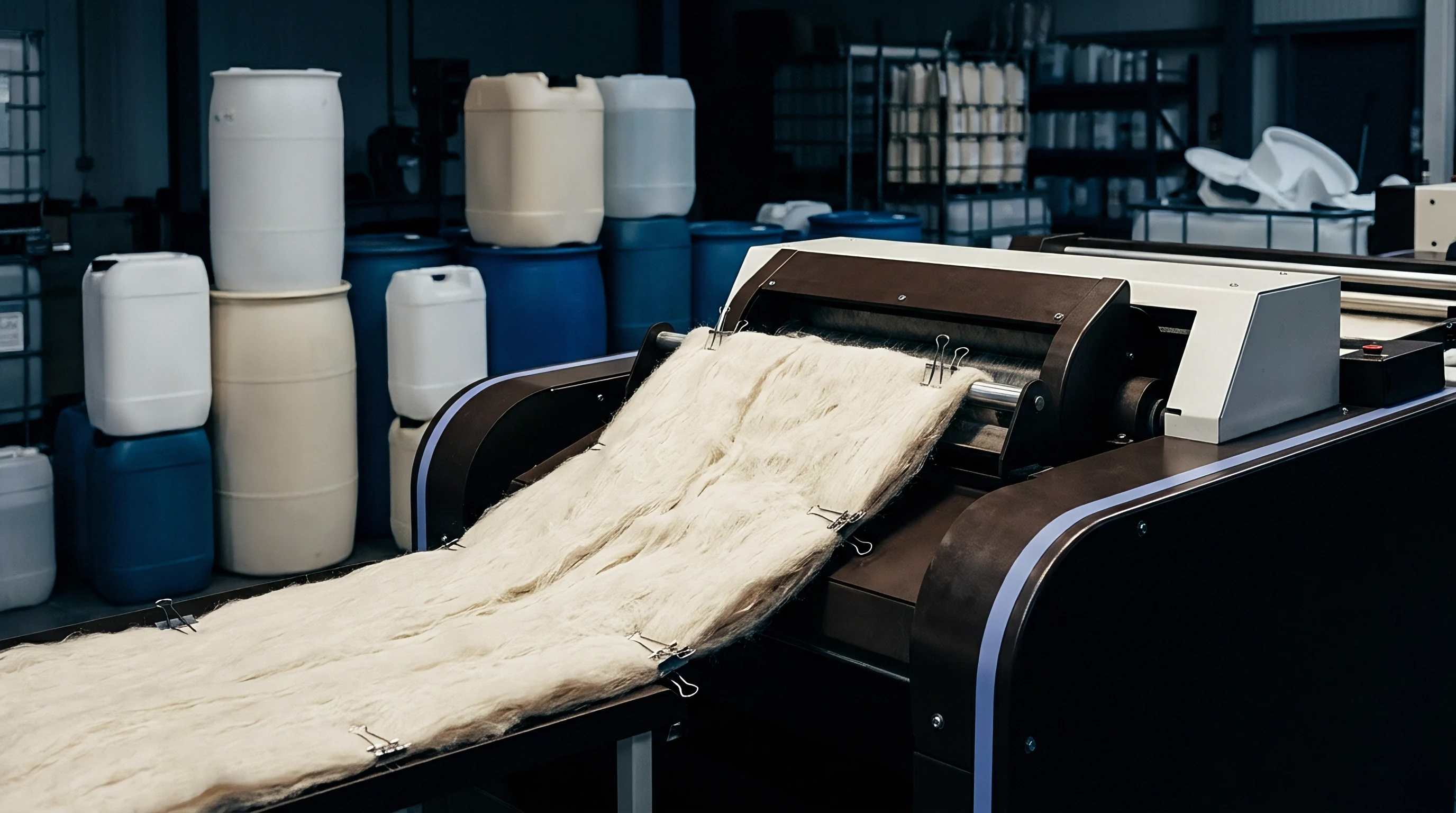
Slubbing frames transform drawn slivers into low-twist strands wound onto wooden bobbins. Roving preparation forms the physical and chemical bridge between mechanical hackling and final wet or dry spinning. Chemical treatment applied to roving packages solubilizes residual phenolics, enabling precise draft control inside the spinning trough.
Chemical Softening in the Roving Treatment Trough
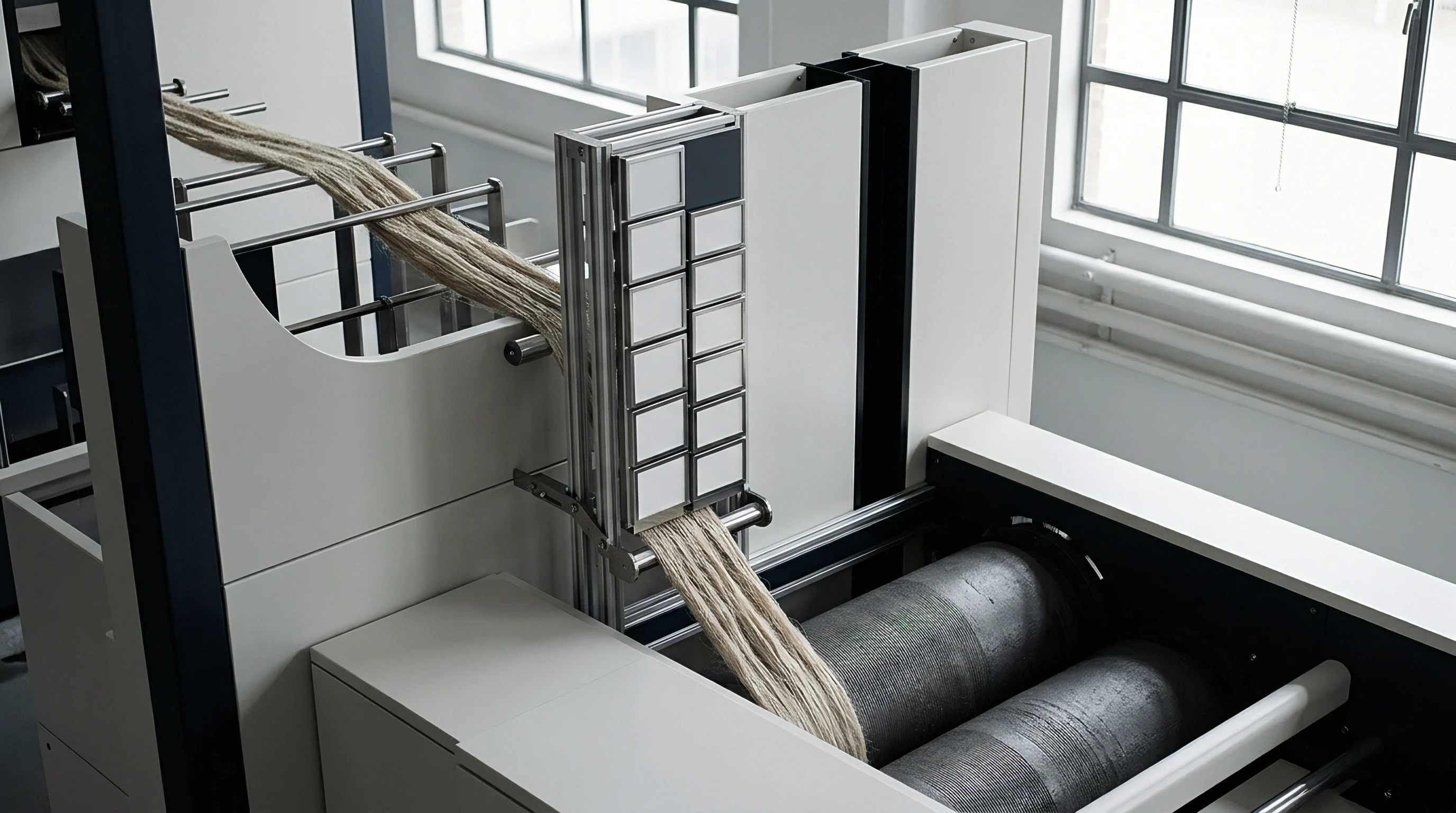
Boiling low-twist packages in sodium carbonate solution solubilizes structural binders prior to spinning. Roving bobbins undergo pressurized aqueous treatment at temperatures between 60 and 80 degrees Celsius using soda ash (Na2CO3) concentrations ranging from 2.0 to 5.0 grams per liter. Alkaline hydrolysis targets remaining ester linkages between ferulic acid and hemicellulose, saponifying residual plant fats and swelling the lignin matrix.
Solubilization lowers bundle cohesion just enough to permit fiber-to-fiber slippage under the drafting rollers. If roving boil conditions are too mild, un-softened lignin maintains bundle rigidity, inducing draft resistance, stick-slip motion, and heavy yarn irregularity (thin-thick places). Harsh alkaline treatment dissolves essential structural lignin, causing roving strands to wash out or break under tension inside the spinning bath before reaching the drafting nip.
Wet spinning frames utilize hot water baths held between 60 and 70 degrees Celsius positioned directly upstream of the drafting zone. Water temperature must remain above the glass transition temperature (Tg) of wet pectin-lignin complexes, which lies near 55 degrees Celsius. Operating the wet trough at 65 degrees Celsius softens residual phenolics, allowing single elementary fibers to slip smoothly over adjacent fibers during high-draft attenuation.
Drafting Dynamics and Maximum Spinnable Count
Hot water baths held between 60 and 70 degrees Celsius reduce the flexural modulus of phenolic binders. Drafting forces measured at the front rollers reflect the friction created by remaining matrix components. Optimum drafting force stays flat between 1.5 and 2.5 Newtons per kilotex of roving.
Residual lignin content above 2.8 percent increases drafting force beyond 4.0 Newtons per kilotex, exceeding the holding power of back roller nips and causing frame stoppages.
| Klason Lignin wt% | Roving Soda Ash g/L | Trough Temp °C | Max Spinnable Count Nm | End Breaks / 1000 Spindle Hr | Yarn Tenacity cN/tex |
|---|---|---|---|---|---|
| 1.5 to 1.8 % | 2.0 g/L | 55 °C | Nm 80 (12.5 tex) | 18 | 28.5 cN/tex |
| 1.9 to 2.3 % | 3.5 g/L | 65 °C | Nm 60 (16.6 tex) | 24 | 31.0 cN/tex |
| 2.4 to 2.8 % | 5.0 g/L | 75 °C | Nm 39 (25.6 tex) | 42 | 26.0 cN/tex |
| 2.9 to 3.5 % | 7.0 g/L | 85 °C | Nm 26 (38.4 tex) | 85 | 21.2 cN/tex |
A structured qualification sequence validates incoming roving performance before full production commit on wet spinning frames.
- Sample three bobbins per lot from middle and outer bale positions.
- Wind 100-meter skeins to verify linear mass density in tex under ISO 2060 conditioning.
- Subject test bobbins to 3.5 grams per liter soda ash boil at 70 degrees Celsius for 45 minutes.
- Measure residual Klason lignin on dried roving samples to confirm target range between 1.8 and 2.2 percent.
- Mount bobbins on a single-spindle test frame equipped with hot wet trough held at 65 degrees Celsius.
- Increase drafting ratio incrementally from 10 to 22, recording drafting force peak-to-valley variance.
- Spin 5,000 spindle-meters at target metric count Nm 50, counting all yarn breakage events.
- Reject lots demonstrating drafting force standard deviation exceeding 0.6 Newtons per kilotex.
When Does Alkaline Trough Treatment Remove Bound Lignin?
Alkaline additions directly to the wet spinning trough alter binder solubility during high-speed drafting. Adding 1.0 to 2.0 grams per liter of sodium hydroxide (NaOH) to the trough liquid drops residual lignin content dynamically during the three-second immersion window. Chemical consumption, equipment corrosion, and waste neutralization expenses must be weighed against the ability to process coarser, higher-lignin fiber lots into fine counts.
Mill engineers determine whether chemical cost per kilogram in the trough offsets the raw material price discount of under-retted fiber.

Audit
Incoming raw material verification requires systematic core sampling from incoming compressed bales. Mill intake controls verify that landed fiber shipments match specification sheets submitted during commercial negotiations.

Bale Core Sampling and Moisture Correction
Hydraulic core drills extract inner fiber samples across at least 10 percent of incoming bale numbers. Standard testing under ISO 6741 mandates conditioning samples at 20 degrees Celsius and 65 percent relative humidity until moisture equilibrium is reached. Flax commercial regain is fixed at 12.0 percent by weight.
Moisture contents above 13.5 percent induce enzymatic self-heating and localized mould proliferation inside densely packed bales, altering non-cellulosic fiber fractions during transit.
Dry mass determination precedes all chemical assays. Core samples undergo moisture testing via oven drying at 105 degrees Celsius until mass changes by less than 0.1 percent across 15-minute intervals. Analytical results express lignin content strictly as a percentage of moisture-free, extract-free dry fiber mass.
Failure to correct for moisture regain leads to false pass results on incoming inspection logs, as water weight lowers the perceived percentage of non-cellulosic constituents.
Laboratory analytical metrics guide raw material quality ratings and contract valuation.
Dossier Structure and Discrepancy Reconciliation
Commercial shipping documentation links laboratory analytical certificates directly to individual bale tags. Quality dossiers accompanying raw bast fiber shipments must include complete material provenance alongside chemical and physical test metrics.
A decision matrix guides quality assurance managers through intake rejection protocols when laboratory metrics diverge from contract terms.
- Klason Lignin Above Band demands immediate re-testing using Acid Detergent Lignin to check shive ratio before lot rejection.
- Moisture Content Above 14 Percent requires weight adjustment on the invoice alongside immediate bale opening to prevent rot.
- Hackling Yield Drop Exceeding 3 Percent triggers commercial renegotiation of the per-kilogram landed price based on lower line yield.
- High Inter-Bale Variance exceeding a coefficient of variation of 12 percent mandates 100 percent lot sampling prior to spinning preparation.
Technical compliance relies on comprehensive documentation containing standardized lab parameters validated prior to bale breaking.
- Origin and Retting Certificate detailing geographic harvest site, retting methodology, and total retting duration in days.
- Chemical Assay Sheet certifying Klason lignin, acid-soluble phenolics, and ash content performed per ISO 13906.
- Physical Fiber Report reporting mean bundle length, metric fineness (Nm), and bundle tenacity measured in centinewtons per tex under ISO 2370.
- Moisture and Weight Certificate declaring net mass, moisture content, and commercial dry mass calculation per ISO 6741.
- Shive and Trash Content Analysis stating percentage by weight of unretted core shive, bark, and extraneous material.
Commercial contracts incorporating ISO 13906 testing standard clauses allow buyers to automatically levy price adjustments when residual Klason lignin exceeds contract maximums by more than 0.3 percent.
Reconciliation clauses in long-term supply contracts specify that seller lab reports are overridden by independent third-party lab testing whenever lot values differ by more than 0.4 percent Klason lignin. In accordance with standard European flax trading rules under C.E.L.C. terms, buyer claims regarding non-conforming lignin content must be lodged within 14 business days of delivery at the destination mill.


Contract
Commercial transactions for scutched long flax and hackled line operate on landed yield calculations. Raw material pricing scales with spinnable metric count capacity, which connects directly to fiber refinement and residual phenolic content.
Yield Arithmetic from Scutched Straw to Spun Yarn
Raw fiber pricing reflects initial mass rather than spinnable long-line yield. Scutched long flax purchases must factor in hackling loss, tow recovery, and roving boil mass loss to establish the true cost per kilogram of spinnable fiber at the spinning frame intake.
Consider a sourcing scenario evaluating two 20-metric-ton lots of scutched long-line flax imported for wet spinning fine yarn at count Nm 50 (20 tex).
Lot A features a residual Klason lignin content of 2.1 percent, purchased at a raw landed price of $4.20 per kilogram. Hackling yields 68 percent long-line fiber and 26 percent hackling tow, with 6 percent comb waste. Roving chemical boil mass loss equals 4.5 percent.
Net long-line fiber available for wet spinning equals 13,000 kilograms (from 20,000 kg raw material taking into account long-line yield and roving boil loss). Hackling tow is credited back at $1.50 per kilogram ($7,800 total credit).
Lot B represents under-retted material carrying 3.2 percent Klason lignin, offered at a discounted raw landed price of $3.50 per kilogram. Due to higher bundle stiffness, hackling yields only 54 percent long-line fiber and 38 percent tow, with 8 percent comb waste. Roving chemical boil requires harsher alkaline conditions, increasing boil mass loss to 7.0 percent.
Net long-line fiber available for wet spinning equals 10,002 kilograms. Hackling tow credit at $1.50 per kilogram equals $11,400.
| Cost Component | Lot A (Optimal Retting) | Lot B (Under-Retted) |
|---|---|---|
| Scutched Raw Fiber Price ($/kg) | $4.20 / kg | $3.50 / kg |
| Klason Lignin Content (%) | 2.1 % | 3.2 % |
| Hackling Long-Line Yield (%) | 68.0 % | 54.0 % |
| Net Hackled Line Cost ($/kg) | $5.60 / kg | $5.33 / kg |
| Roving Chemical Boil Cost ($/kg) | $0.45 / kg | $0.75 / kg |
| Wet Spinning Efficiency (%) | 94.5 % | 82.0 % |
| Frame End Breaks per 1000 Spindle Hours | 22 | 78 |
| Final Spun Yarn Landed Cost ($/kg) | $8.15 / kg | $9.85 / kg |
| Woven Fabric Landed Cost ($/m at 150 g/m²) | $1.83 / m | $2.21 / m |

Landed Cost Modeling across Finished Fabric Metres
Downstream weaving operations convert yarn linear mass into finished fabric square weight. Processing Lot B incurs significant economic penalties during wet spinning. Higher end breaks drop frame operating efficiency from 94.5 percent down to 82.0 percent, increasing labor and overhead absorption costs.
The actual landed cost of spun Nm 50 yarn rises from $8.15 per kilogram for Lot A to $9.85 per kilogram for Lot B, offsetting the initial raw material price discount of $0.70 per kilogram.
Converting spun yarn into plain grey linen fabric with a target weight of 150 grams per square meter at 150 centimeters finished width illustrates the financial outcome. Fabric manufactured from Lot A yarn lands at a total material and conversion cost of $1.83 per linear meter. Fabric produced from Lot B yarn reaches a landed cost of $2.21 per linear meter, representing a 20.7 percent cost penalty driven by residual lignin defects present in the raw fiber.
Mill sourcing strategies prioritizing raw purchase price over verified chemical lignin parameters frequently yield higher final costs per finished meter due to processing waste, elevated chemical consumption, and lost spinning productivity.